Clinical Data

Phase Ia (AMD-1)
Safety and Initial Efficacy

  1. No compound-related safety issues
  2. Significant improvement in visual acuity over Eylea monotherapy in previously treated patients, demonstrating improved retinal functioning
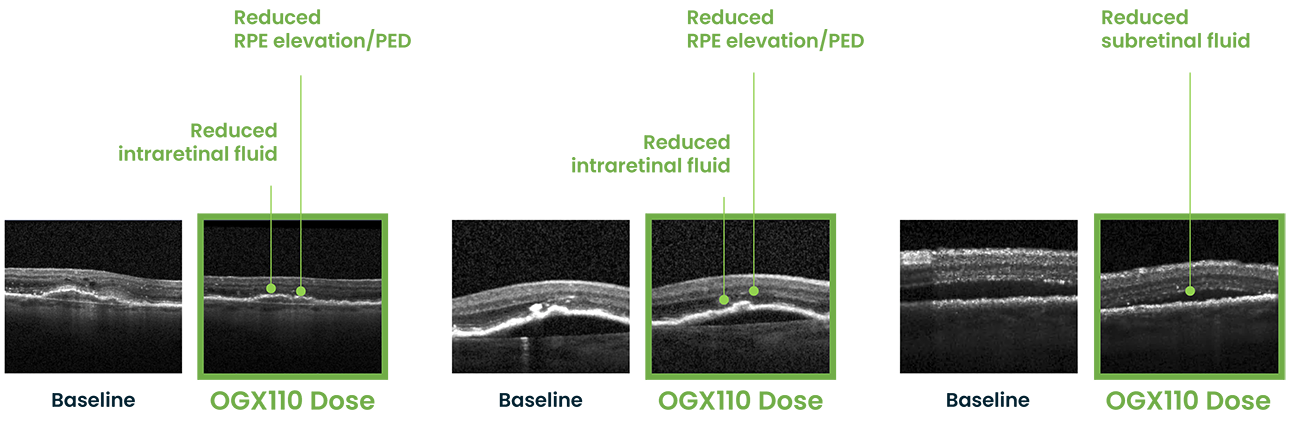
  3. Significant anatomical changes, almost completely resolving Intraretinal Fluid (IRF), Subretinal Fluid (SRF), and Pigment Epithelial Detachment (PED), a consequence of angio-regression
  4. Regression of the pathological vasculature, likely contributing to the long-term effect of the treatment
  5. Resolution of SHRM, a biomarker for developing fibrosis and atrophy, providing an indication of anti-fibrotic activity
  6. Significant increase in time between administrations. BCVA at five or six months was as high as any other point in the regimen, suggesting restoration of homeostasis and disease modification

Phase IIa (AMD-2)

Multiple Efficacy Endpoints

Ocugenix has performed trials that have built a compelling story in several critical areas of wet AMD

Fluid Resolution (IRF & SRF)

Vascular regression and reduction of edema/decrease of fluid in active disease

Anti-Fibrotic Activity (SHRM Resolution)

Early elimination of SHRM is supportive

Vascular Regression

BCVA vision improvement well beyond that noted with Eylea in our Phase 1a patients

Extended Treatment-Free Interval (Disease Modification)

CXCR3 signaling restored homeostasis as noted by prolonged disease-free intervals

Anatomic evidence that OGX110 decreases fluid after one dose (no anti-VEGFs)

In all three treatment-naïve patients with active exudative AMD, examination of the SD-OCT after a single dose of OGX110 showed resolution of intraretinal fluid, subretinal fluid, and the reduction in pigmented epithelial separation from the underlying eye.

This is consistent with what would be seen as a good response to anti-VEGF therapy. And this is the first demonstration of reduced retinal fluid for an agent other than one that targets VEGF activities.
Ian P. Conner, M.D., Ph.D.

Founder and Clinical Advisor
Dr. Ian Conner is an assistant professor of ophthalmology and bioengineering at the University of Pittsburgh and the director of the UPMC Eye Center. Through an unrestricted grant from the Research to Prevent Blindness (RPB), Dr. Conner has collaborated with faculty members affiliated with the McGowan Institute for Regenerative Medicine to investigate the structural, metabolic, and functional relationships between the eye and the brain in glaucoma. In addition to his research efforts, Dr. Conner has served as site investigator on several UPMC Eye Center clinical studies on glaucoma and ocular hypertension.

Cecelia C. Yates, Ph.D.

Founder and Scientific Advisor
Dr. Cecilia Yates is an associate professor of health promotion and development at UPMC School of Nursing. Dr. Yates’ research focuses on chemokine and extracellular matrix interactions in systemic sclerosis (scleroderma) and idiopathic pulmonary fibrosis in the development of dermal and pulmonary fibrosis. She has a cellular and molecular laboratory fully equipped for basic and translational research located within the School of Nursing. Current members of the laboratory are investigating genomic regulation of molecules that mediate the development and progression of fibrosis. Dr. Yates is also developing small molecule therapeutics and cellular therapies to improve tissue remodeling.

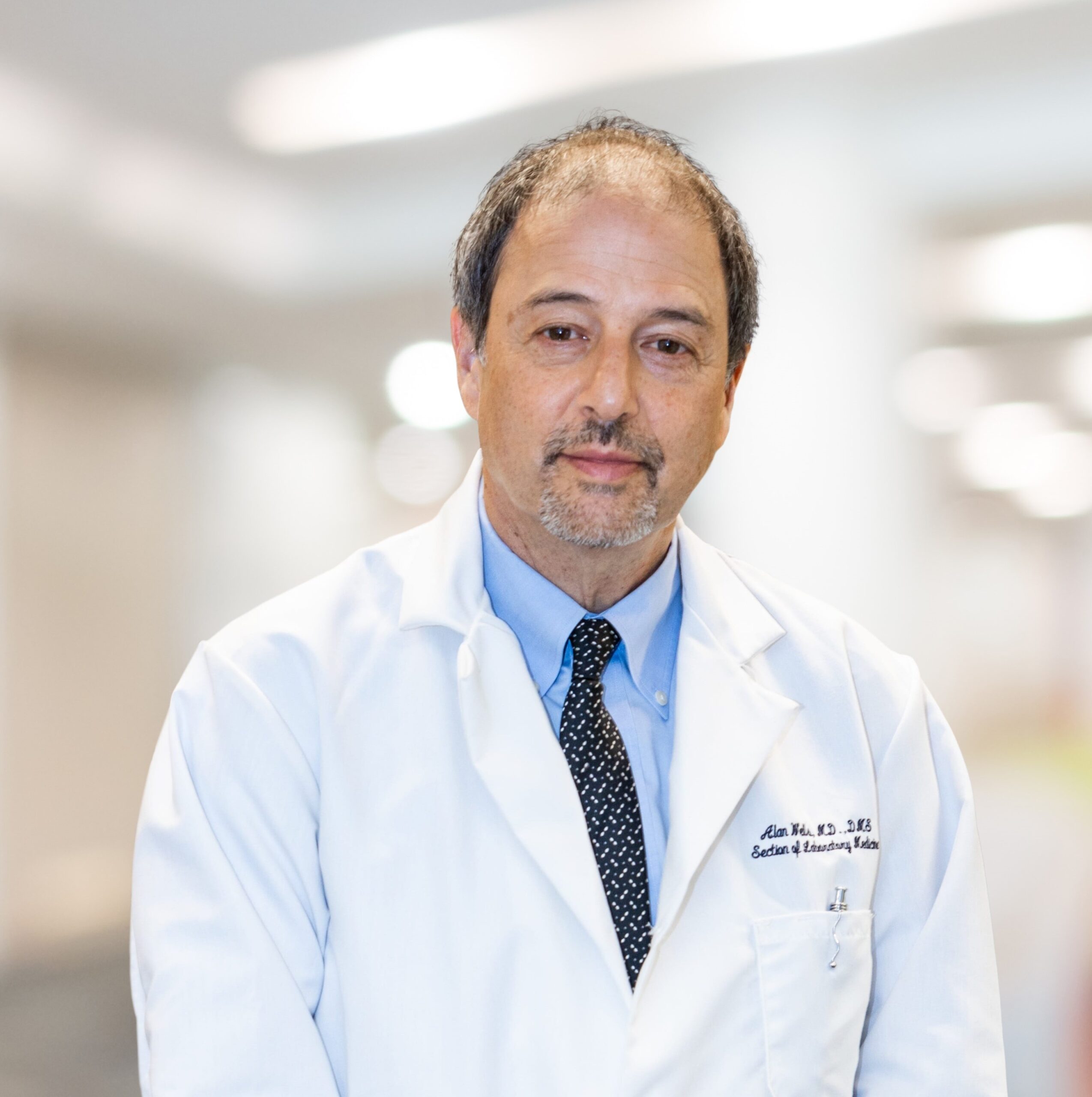
Alan Wells, M.D., DMS

Founder and Chief Scientific Officer
Dr. Alan Wells is the Thomas J. Gill III Professor of Pathology and the executive vice-chairman of the department of pathology at the University of Pittsburgh. In addition, Dr. Wells is a professor of bioengineering and computational & systems biology (secondary appointments) and a staff physician at the Veterans Administration Medical Center in Pittsburgh, Pennsylvania. Dr. Wells holds an AB in biochemistry from Brown University (1979) and received his DMS in tumor biology from the Karolinska Institute in Stockholm, Sweden, in 1982. Returning to Providence, Rhode Island, he received his MD from Brown University in 1988. Following his studies, Dr. Wells completed a postdoctoral fellowship in tumor biology at the University of California in San Francisco, California, and a residency in laboratory medicine at the University of California in San Diego, California.
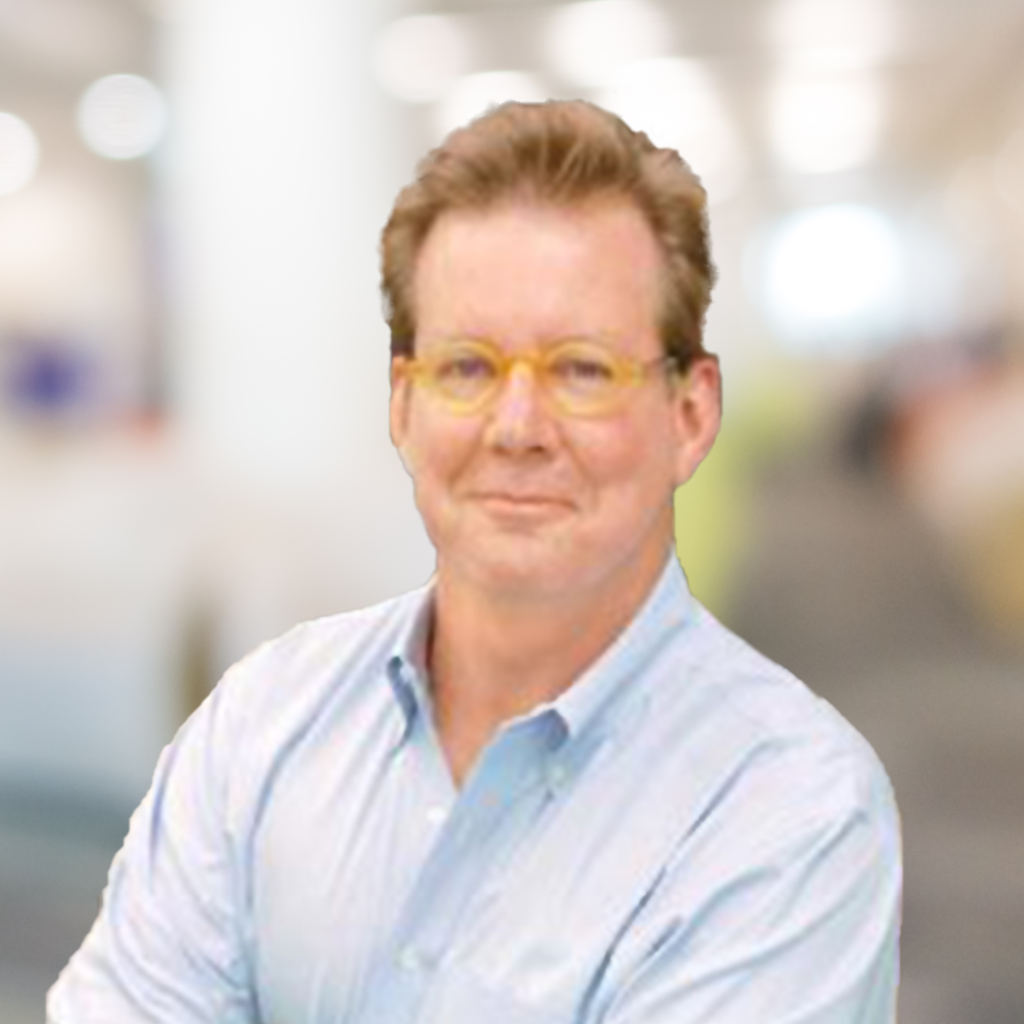
Sean McDonald, CEO

Sean McDonald

Founder and Chief Executive Officer

Sean McDonald has a track record of building start-ups from early stages of venture capital investment to self-sufficient revenue generation. He previously led Precision Therapeutics, a market-leading personalized medicine company, that he grew through both internal development as well as acquisitions to $40 million in revenue.

During Mr. McDonald’s tenure as CEO, Precision Therapeutics developed the most diversified portfolio in the industry of validated personalized medicine products impacting lung, colon and gynecological cancers. Earlier in his career, he founded Automated Healthcare, a company that developed the first systems that automated the dispensing of medications in hospital pharmacies. The system has been successfully deployed in several hundred hospital pharmacies across the country and dispenses a half a billion prescriptions. Mr. McDonald grew that business from startup to close to $200 million in revenue.

Alan Wells, M.D., DMS

Founder and Chief Scientific Officer
Dr. Alan Wells is the Thomas J. Gill III Professor of Pathology and the executive vice-chairman of the department of pathology at the University of Pittsburgh. In addition, Dr. Wells is a professor of bioengineering and computational & systems biology (secondary appointments) and a staff physician at the Veterans Administration Medical Center in Pittsburgh, Pennsylvania. Dr. Wells holds an AB in biochemistry from Brown University (1979) and received his DMS in tumor biology from the Karolinska Institute in Stockholm, Sweden, in 1982. Returning to Providence, Rhode Island, he received his MD from Brown University in 1988. Following his studies, Dr. Wells completed a postdoctoral fellowship in tumor biology at the University of California in San Francisco, California, and a residency in laboratory medicine at the University of California in San Diego, California.